Saturday, 26 May 2012

Madagascar :))


Everytime I see an aeroplane fly overhead I always think to myself where in the world are they going? My dad probably knows! As an avian enthusiast and simulator pilot he tunes into the radio control tower and fly’s their routes on his simulator! I’m not that geeky! Not about aeroplanes that is! But when it comes to wildlife and faraway places well I’m more than geeky I’m a little enchanted! To say the least! So it is with great trepidation and excitement to think that in less than a month I won’t be looking at a plane wondering where it’s going but instead I’ll be boarding one to one of the most astonishing countries on the planet, one I’ve long had an infatuation with….. the mystical and diverse land of MADAGASCAR!
I can only read one page of the guidebook at a time before I either boil with excitement at the wonderfully diverse fauna and flora we’re going to encounter or shiver with fear at the horror stories of bugs that burrow deep into your flesh and lay their eggs beneath your skin which can only be extracted with a hot blade and a bottle of strong rum!! My reaction was the same! Shut the book and run a mile!! But there is nothing that could deter me from wanting to explore the wonders that Madagascar has to offer from the eerie skin crawling cries of the Indri to the bazaar long fingered tapping aye-aye, not to mention the array of extraordinary birds, insects, reptiles, plants, marine life as well as madagascar’s diverse ethnic people, Antaifasy-People of the sands, Antankarana-those of the rocks, Antaimoro-people of the coast, Antandroy-people of the thorns,Antanosy-people of the island, Merina-people of the highlands just to mention a few.

With only a month to explore an island bigger than the UK, the map in the guidebook is marked north to south, east to west with dog ears, sticky notes and pen marks of National Parks and Marine spectacles such as the humpback birthing season starting in June, not to be missed! But I know the minute we set foot on the dusty runway all the planning and OCD preparations will evaporate into thin air because Madagascar like one of its tiny inhabitants I’m currently fostering which is critically endangered in its native habitat will forge its own route and map with steely determination, for a land which harbours secrets like lemurs and giraffe necked weevils will not be told but will amaze, astound, startle and overwhelm us for that I am sure, and I cannot wait to share the journey and its secrets with you here when we return……… watch this space!


Regards Nic x

Saturday, 8 October 2011

Marine Turtle Conservation Project, Cyprus

Along a dusty winding track in the wilds of Northern Cyprus stands a pair of green turtle gates beyond which lies an outback house called Alagadi Goat Shed. Recently I went to visit Matt & Austin on their Escape Committee adventure as they reached Cyprus. It was our discovery of the Goat Shed which led to me standing ankle deep in the Meditearean late one evening, under a full moon, releasing baby green turtles into the ocean.
The beaches of Northern Cyprus are home to two endangered species of Turtle; Loggerhead turtle Caretta caretta and Green turtle Chelonia mydas. These turtles come ashore from May through to August to lay their precious cargo of eggs on the same beaches that they themselves hatched on, some up to 30 years earlier.
However, the threats to nesting females and hatchlings are so great that in 1992 the University of Exeter founded the Marine Turtle Conservation Project to help conserve these endearing creatures in conjuction with the Society for Protection of Turtles in Northern Cyprus.
The project is run by volunteers who are mainly students from the University of Exeter lead by Kim Stokes who is currently completing her PhD on the response of marine vertebrates to climatic change.

I was lucky enough to meet the lovely Kim and accompany her team on a Green turtle nest excavation which provides important data on the success of nests and survival rates of hatchlings. The excavation the day before produced only one hatchling. On the day I joined them the nest produced eighty healthy Green turtle hatchlings which would be released later that evening. Coming face to face with a baby turtle was one of the most precious animal encounters I've ever had. They face such insurmountable obstacles on their journeys from the nest to the sea and beyond it's a wonder any of them make it at all. But their plucky little characters say it all, from the minute they surface from the nest their flippers are in full swing instinctively wanting to swim. Volunteers patrol the main nesting beaches both day and night recording important data such as carapace length and width along with the pattern and amount of scutes on the shell on both nesting females and hatchlings. Some of the nesting females are fitted with satellite tags and tracked.


Later that evening after a delightful dinner cooked by the volunteers I accompanied them back to the beach to release the hatchlings excavated at dusk. It was an unforgettable moment as a line was drawn on the sand to mark their starting point and the hatchlings were positioned for release, on the count of 3 the shoreline swarmed with baby turtle activity, their little bodies writhing on the sand desperate for their first taste of freedom, and in seconds they were gone, out into the deep blue ocean to fend for themselves. The next time they emerge will be to nest on the very same beach they were released on, provided they make it back.
x Good luck on your journeys little Green turtles x

All the best
Nicole
Nicole Fenton Tag-a-Turtle blog

Saturday, 18 June 2011

Great White Cage Dive South Africa


I knew the time would fly by and it certainly has! Planning my trip to South Africa and to visit the Great White Sharks of Gaansbaai in Cape Town seemed to take ages but I can’t believe it’s come and gone already! As quickly as the day went by, it is one of those moments in life I will never forget! Coming face to face with a Great White Shark, twelve of them to be exact!


The Tag a Turtle ethos is deep rooted in the conservation of all marine species and as well as the plight of turtles we are strong advocates for shark conservation. One of the main reasons I wanted to get so close to these astounding creatures is to highlight their struggle for survival amongst other marine species in the wild.
The Dyer Island Conservation Trust specialises in the protection of Great White Sharks (Carcharodon carcharias) in this biodiversity hotspot which is home to one of the largest populations of Great Whites in the world as well as an important breeding area for the endangered Southern Right Whale (Eubalaena australis) and one of the few remaining breeding colonies of the African Penguin (Spheniscus demersus).


It is also home to large resident populations of dolphins, Cape Fur seals (Arctocephalus pusillus) and thousands of seabirds.
Great Whites are naturally inquisitive and therefore offer fantastic up close viewing opportunities from the safety of a cage. A bit too close for comfort at some stages for me as a great big 4m female kept swimming right up to my side of the cage and peering in at me, before a flick of her tail and she would disappear into deeper water but not before having a chew on the boat’s propeller first! As large and intimidating as they may appear I have to say they are absolutely beautiful and really not the ruthless killers they are often portrayed as.


Marine Dynamics have a dedicated research team tagging and monitoring the behaviour and biology of the Great Whites in the region and offer volunteer/intern programmes for anyone interested in gaining experience working in the field. My pictures of the Great Whites are available to view in the Tag A Turtle photo gallery.

Regards
Nic :)

Cornwall College Green Team Join Tag a Turtle


The cornwall college green team have joined us to help raise funds for Tag A Turtle. This is a huge boost for the project and Nicola & I are so pleased to have them on board! The first event they organised for us was a huge success. It was an evening of entertainment and fundraising at the Mermaid in Porth with brilliant singing and entertaiment by local DJ Seth and Award winning irish singer/songwriter Brian Robb. The evening included a raffle and games with prizes being donated by local businesses. The event was a huge success raising £150 for TAG A TURTLE which was fantastic! Prior to the fundraising evening the Green team did a beach clean on Porth beach. We want to thank everyone in the green team for their hard work in organising the event and to everyone who attended, the event has marked our almost halfway milestone, our current total is now £1430.40. We'll keep everyone posted with upcoming events.

Regards
Nic

Wednesday, 16 February 2011

Tag a Turtle goes live!!


Hi All

Just a quick note to say our Tag a Turtle Website has finally gone live!! It can be viewed at www.tag-a-turtle-.co.uk
And almost as if to commemorate the occasion, my monthly BBC Wildlife magazine popped through the post box today and in it...a seven page spread about 'Arribada,' spanish for 'Arrival from the sea' The arrival being the onslaught of female Olive and Kemp's Ridley Turtles who, driven by an ancient ancestral urge, come ashore the deserted beaches of North West Costa Rica to lay their precious cargo in the sand.
However this is the beginning of a journey that some turtles never even get the chance to make... that is why the Tag a Turtle project to us and to other marine conservationists, biologists, and enthusiasts is so important. To raise awareness for our amazing oceans and all the incredible creatures who roam within them, and how we can make a difference. For all the info, action and events visit the website and for any further info you can contact us at: info@tag-a-turtle.co.uk


Have a great week, see you all after my mushing ventures in finland...
Regards
Nic :)

Tuesday, 1 February 2011

Next venture: Mushing in Finland

Hi everyone,

Unfortunately time has run away with me for when I last checked, it was the first of february, 2011 and I haven't written a single blog since last year!! So hurtling forward in true Nic spirit I've decided to skip what's happened in between then and now and to blog about my next adventure which involves snow and dogs!! As I'm turning the milestone age of .... 21 again this year, I've decided to go to Finland dogsledding with huskies! For those of you who know me I've had a life long infatuation with huskies and the lands where they originate and it's been a dream for sometime, so I'm well and truely excited to finaly have the opportunity to be able to do it.

The January issue of BBC Wildlife magazine did a fantastic write up on 'why dogs rule the world' and how their social and loyal traits which endear them to us have underpinned their extraordinary success in their wild counterparts, the wild members of the Canidae family, wolves and foxes. It's well worth a read or subscription if you're stuck for presents. It feels like xmas every month when I receive my mag through the post :)

For those of you living in the UK or with Sky channels, the BBC have been doing a fantastic series called Human Planet which is an awe-inspiring, jaw-dropping, heart-stopping series that marvels at mankind's incredible relationship with nature in some of the most arduous places on the planet today. The series explores the remarkable stories of people who make their homes in places on the planet most of us would think of as uninhabitatable. The arctic episode shows a family set out across the sea ice with their beloved dogs in the springtime to catch a Greenland shark and shows how the Inuit mussel-gatherers venture underneath the sea ice at low tide, risking their lives in a perilous race against time as they gather vital food stores to last them the winter months. The relationship between these ancient hunter-gatherer people and their dogs is moving. Their dogs are their livelihood as well as their best friends and only companions on what can sometimes turn out to be never ending journey's in the search for food. So if like me you're all inspired to go and visit somewhere even colder than England but to have an experience of a lifetime here are a few suggestions:

Five great places to go dog sledding

1. The North Pole- Obviously this type of adventure is best not done in flip-flops and your old backpack from Mallets. For those tough nuts amongst you this is the mother of all dog sledding trips, but you’ll need some help. There are several companies who will help you ski or dogsled to the North Pole, providing all the kit and support, but obviously its not cheap.
2. Greenland- Ever fancied hurtling through the frozen tundra with only the sound of your dogs, the snow beneath the sled and wind to distract you from the breathtaking beauty of the arctic? Inuit hunters will take you and your dog team out over the ice flows, show you the ropes and teach you how to build true igloos.
3. Finland. Imagine sliding through the dark forests of the Finnish north, visiting the Sami people with their massive herds of reindeer, then each evening, after a sauna, curling up in the warmth and bliss of a wood cabin beneath the Northern Lights.
4. Canada. A little more sedate, Canada offers the same rush but with all the luxuries and ease of a North American holiday. Don’t forget to try the Mongoose jerky when you tire of the maple syrup and pancakes.
5. Kent. What?! Yes for those of you who aren’t fans of the cold, travelling too far or foreign foods you can now learn to dog sled in the England’s Apple Orchard.


Until next time, I promise not to leave it as long...
Nic x

Thursday, 11 November 2010

Land Rover’s commitment to a sustainable future

As we make our way to the end of 2010 and plough our way into the new year we are all faced with daily headlines in the press reminding us of the recession, government cuts, global warming, sustainable living, our ecological footprint, thinking about how we shop, what we buy, organic or free range? Tested on animals? Farmed or fresh? Sustainably fished or hunted to extinction? Thinking about your next move, even if it is just to buy some milk from the corner shop, we are all faced with a number of choices daily which will affect not only our future but the future of our children and future generations. What does the future hold? And can we really influence the bigger picture? And does it really matter? A review article in NewScientist October 09 edition based on the book by Robert and Brenda Vale, two architects who specialise in sustainable living at University of Wellington, New Zealand compared the ecological pawprint of everyday family pets with SUV’s otherwise known as 4x4’s or ‘Sports Utility Vehicles’. The findings were astonishing!
They concluded that a Landcruiser’s eco-footprint is less than half that of a medium sized dog! John Barrett at the Stockholm Environment Institute in York, UK said “Owning a dog really is quite an extravagance, mainly because of the carbon footprint of meat”.

So what is it to be eco-friendly? And how do we achieve it when even our furry friends are no longer seen as being part of a sustainable future?
Well in my opinion we all hold a piece of the future in our hands, every single one of us, so every decision we make on a daily basis will in turn in one way or another affect another human/non human being sometime in the future. Therefore we can all make a difference, even if it’s in a miniscule contribution, a hundred thousand miniscule contributions soon add up! Therefore if you already own a pet, then changing its diet can help. Replacing meat with a more sustainable, less energy intensive replacement can almost halve the eco-pawprint of a dog or reducing the amount of birds a cat kills per year can drastically reduce their huge claw-print. And as for SUV drivers well you’ll be very happy to know that Land Rover have made a promise to a more sustainable future by actively supporting Conservation programs such as the Borneo Orangutan Survival Foundation (BOS) which runs the world’s largest primate rescue project. As part of their sponsorship they have donated a Defender to the Nyaru Menteng Orangutan Reintroduction Project in Central Kalimantan. The vehicle is currently being used in the most remote areas of Borneo for the transportation and return of Orangutan's to safe forests.
So its not all doom and gloom, there is always a greener alternative if we really want to make a greener choice, which made me think twice this week when I decided that the house was far too quiet and I wanted a pet…..
So I’ve decided on 3 bantam hens! At least they compensate for their eco-featherprint by providing eggs although I’m not sure I’m ready to go all the way and be completely eco-friendly by eating them, they’re never going to provide as much entertainment and pleasure on the dinner plate as seeing them pottering around the garden chattering away to each other.

Have a great week.
Nic

Friday, 5 November 2010

Top Ten Wildlife Spots


Emmy Award-winning director and producer of wildlife documentaries, Nick Stringer, walks us through his favourite places in the world to see nature at its finest, in this weeks guardian. Check out his list of top wildlife spots at http://www.guardian.co.uk/travel/2010/nov/03/top-10-wildlife-destinations Which made me think about my top ten favourite travel spots so far which I thought I would share on my blog. Although I have many more places on my wish list yet to see and adventure, my favourites so far have to be.....

1. Bwindi Impenetrable National Park for Gorilla treks and Ngamba Chimp Island, Lake Victoria for Chimpanzees


2. Phi Phi and Kho Lanta Island's, Thailand for diving


3. White Water Rafting the White Nile River in Uganda


4. Tunisia for Swimming with Wild Dolphins


5. Pilansberg National Park South Africa for Elephants and Big Cats


6. Phuza Moya Game Reserve South Africa for Dwarf Mongoose and Hippos


7. Dartmoor National Park, England for salmon leaping, wild swimming and yurting


8. County Clare, Ireland for Birds of Prey and good guiness


9. Lake Nakuru in Kenya for Bird watching, especially Flamingos and Colobus Monkeys


10.Cornwall, UK for snorkelling, seals and basking sharks


Send your comments/favourite travel wildlife spots to me at ukulalana@gmail.com or nicolefentonhowarth on facebook.

Also if you would like to see some amazing travel pics and read up on Japan, check out Matts homepage and blog at matthewbutton.co.uk

Until next time.........Hamba Kahle (Go well)
Nic x

Wednesday, 3 November 2010

As a new species is discovered another is going extinct……..


2010 is proving to be an exciting year indeed! There has never been a better time to celebrate the International Year of Biodiversity with a new species of primate being discovered! Fauna & Flora International was part of a team of primatologists that recently discovered a completely new species of monkey Rhinopithecus strykeri in Northern Myanmar (formerly Burma). Local hunters reported the presence of a monkey which did not match any description of species previously identified in the area. Sadly this latest addition to the snub-nosed family is already threatened. Hunting pressure is rising thanks to loggers moving into the previously isolated distribution area of this species. Based on direct observations and evidence from local people, the team of researchers have estimated the total population of R.strykeri to be 260-330 individuals, making them a threatened species when they’ve only just been discovered. All species of snub-nosed monkey are considered critically endangered, including the striking blue-faced R.roxellana or golden snub-nosed monkey. With the new snub-nosed monkey Myanmar has now 15 species of primates, which underlines the importance of Myanmar for biodiversity conservation.

Photo credit: A digital reconstruction of the Burmese Snub-nosed monkey by Dr Thomas Geissmann

Hunting and habitat destruction are the key threats facing all primate species including the great apes. Just over 700 mountain gorillas remain in the world today. Two isolated populations survive, one in the Bwindi Impenetrable National Park, south-western Uganda, and the other on the forested slopes of the Virunga volcanoes, straddling the borders of the Democratic Republic of Congo (DRC), Rwanda and Uganda. The forest has been recognised as one of the most biologically diverse areas on earth by the United Nations Educational, Scientific and Cultural Organisation (UNESCO) as a World Heritage Site.


In 2003 I visited the magnificent Bwindi Impenetrable Forrest, home to half the world’s population of critically endangered Mountain Gorillas Gorilla beringei beringei. It was an unbelievable experience, one which I will never forget. We trekked for over two hours through the humidity of the forest and up steep inclines until one of the conservation guards held up his hand and told us to be very quiet as he had detected fresh signs of gorilla activity. Within minutes we were surrounded by them. There were mothers and babies all around us, feeding, playing and before we knew it the silver back roared past us in an attempt to show us who’s territory we were on, before sitting down and beating his chest wildly with satisfaction.


My heart was beating so fast I thought I was going to faint. We could only spend an hour with them and then we had to leave to prevent any cross contamination of disease, so I snapped as many quick photographs as I could get whilst hanging onto a branch to stop myself slipping down the ravine, hence the blurred photos, and then spent the rest of the time just watching them and being among them for I knew there and then that I may never get the opportunity again to walk and be amongst wild free Gorilla’s.
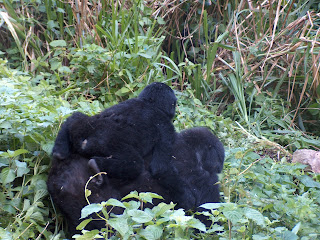

The only reason there still are this tiny number of wild Gorilla’s still living and roaming the forests free today is down to the countless hours of dedication and commitment of the national park staff who patrol these forests on a daily basis to protect the Gorilla’s from hunters and poaching. But these conservation efforts have cost many lives, both human and Gorilla, for life is cheap in Africa and a Gorilla to a man and his starving family is just another meal to survive yet another tough day in Africa.

Lets hope the next generation of conservationists and their efforts can help build a stronger future for all the amazing species which share our beautiful planet with us.


Comments are welcome and can be sent to ukulalana@gmail.com if you are not a google mail user. Have a brilliant week.
Regards
Nic x

Thursday, 21 October 2010

Where the wild things are...


I have lived my entire life in Africa, running around barefoot, with acacia trees which grow thorns the size of toothpicks everywhere and managed to get away relatively unscathed, and yet you couldn’t find anyone on the planet less adapted to survive in the lush green English countryside. For, lurking underneath all that lush green grass, pretty blue bells and fields of daisies are the most dangerous and spiteful plants I have ever encountered! The dreaded STINGING NETTLE. Last night while frolicking in a field with the Kuni kuni piglets that I am currently babysitting, as the sun set over the rolling English countryside, I managed to find the only patch of nettles in the entire field and sit on them! I nearly gave the poor pigs heart failure as I ran around like a chicken on fire trying to work out what had attacked me so viciously, only to discover it was a clump of dammed leaves.


Anyway, enough about my inability to survive life on this small island with its peculiar range of deadly South African eating plants, I want to blog about the next chapter, in what is turning out to be quite an unfolding adventure, that is my little existence in Cornwall.


I’m graduating on the 6th of November, so armed with my BSc honours degree and truck loads of enthusiasm I’ve been filling every spare minute of my time volunteering for various conservation organisations such as the Royal Society for the Protection of Birds, Cornwall Wildlife Trust, and of course running the tag a turtle project with Blue Reef and the Marine Conservation Society, in the hope that not only will I gain some invaluable experience but that somewhere along the line I will hopefully build a career. So it was to my complete surprise when the Director of Newquay Zoo contacted me last week and offered me the opportunity to join their team as a Primate Keeper! This will give me the wonderful chance of working with these fascinating animals (lemurs, marmosets, monkeys and apes to name a few) up close and enabling me to observe and record behaviours which will contribute to their conservation in the wild.

Newquay Zoo is part of the Whitley Wildlife Conservation Trust (WWCT). The WWCT operates and supports over 20 UK and overseas conservation projects. Newquay Zoo recently signed up to the World Land Trust's Wild Spaces project with the British and Irish Association of Zoos and Aquariums (BIAZA). This aims to raise £260,000 to purchase a critically threatened 3,675 acre (1,500 ha) parcel of strategically placed land in the Brazilian Atlantic forests, home to over 930 bird species and 260 mammal species.
The World Land Trust takes direct action to save tropical and other wilderness land. They buy it, acre by acre and are currently working to create new reserves to save threatened habitats in Brazil, Ecuador and India. To find out more please visit their website.
Another great project at the moment worth mentioning is the The Tiger Corridor Initiative promoted by the conservation organization Panthera. It hopes to secure a major wildlife conservation corridor which could extend along the foothills of the Himalayas from Nepal into Bhutan and northern India, then through to Myanmar, stretching across 2000km with an area of 120,000 sq km. The ambition would then be to connect it to another corridor spanning Thailand, Laos, Cambodia, terminating in Malaysia.


The amazing images in this blog were taken by Matt Button on our recent trip to Newquay’s sister Zoo Paignton in Devon (where we will be visiting again next week for a week of hiking on Dartmoor) and are all of critically endangered species which need protection if we are to conserve them for future generations.

Look out for my next blog on my visit to the wild Gorrilla’s in Bwindi Impenetrable
Forrest in Uganda…

Have a great week
Nic x